Friday, October 28, 2011

Few and Far Between

You will have noticed that my posts have gotten less regular and less frequent - well, it will not improve - I will start assuming a new international assignment soon, which will divert much of my (spare) attention to the new job.

However, as a "wrap-up" of the past few years, I have gotten the opportunity to present my experience in Brazil at the GIZ in Bonn.

If you are interested, you are welcome to show up for my presentation (in German). Save the date:

Vortrag: Land der Zukunft? Erfahrung eines Deutschen Managers in Brasilien
Datum/Uhrzeit: 29.11.2009 (Dienstag), 19h30

Ort: Gesellschaft für Internationale Zusammenarbeit (GIZ), Friedrich-Ebert-Allee 40, 53113 Bonn


Flyer Vorderseite und Rückseite.

Tuesday, September 20, 2011

China 4 - 0 Brazil

When Brazil was competitive
I know that I am exagerating when I say that Brazil is only competitive in football (soccer) - even though they have recently lost a friendly against Germany. 

However, after this loss they decided to cancel all "classics" (games against top teams) and only play against teams such as Ghana, Guinea and others. A recent game against Argentina in the Roca Cup ended 0-0 - the rematch will be at the end of this month.

Unfortunately this reaction is very exemplary for a Brazilian behavior style. Recently, imported cars have been flooding into the country - especially Hyundai has been very succesful and is even in the process of building a huge plant. On the lower end, the Chinese companies JAC and Chery have entered the country with a bang and riding on a weak USD, opening dealerships and advertising heavily - both are also planning on building plants. And on the upper end, Jaguar, BMW (also planning a plant), Audi, and even Mini have been extremely succesful catering to the wealthy. What was the reaction of the government?: Slap on (even) more taxes on imported cars (i.e. outside of Mercosul) and cars with less than 65% local content (local producers have 45 day grace period). This will raise the average price of most cars not qualifying for exemption by 25% or more, thus killing off the efforts of many of the new emergents. This will not help the Brazilian car industry which already sells expensive and mediocre cars - ask a Brazilian for his opinion the best that is locally produced and he will, without a blink of the eye tell you: Omega!

Where was I? Competitiveness: The World Economic Forum has released their latest competitiveness index and, surprise surprise, Brazil did not showcase well. And this is not related to the companies itself - although there are also weakness there. Brazil finished overall in 53rd place (of 142), better by 5 positions since the last time and on par with India (56th), but way behind China (26th). What drags down Brazil are
"[...] the lagging quality of its overall infrastructure (104th) despite its Growth Acceleration Programme (PAC), its macroeconomic imbalances (115th), the poor overall quality of its educational system (115th), the rigidities in its labor market (121st), and insufficient progress to boost competition (132nd) are areas of increasing concern."
Brazil is saved by market size (10th) - but even business environment (31st), financial markets (40th), technological adoption (44th) and innovation (47) are only midfield.

So overall, Brazil has improved but still is far from being a future leader and if we look very closely, indicators under strong governmental influence perform much poorer than those which are driven by the private sector... Drive on the local roads, fly into any airport, try to hire somebody with an intermediate level of English-speaking skills (or try to fire them later!) and you will know why.

Well, at least Brazil is still better than Argentina in competitiveness. Argentina is currently ranked 85th.

BTW, the top 10 this year were Switzerland, Singapore, Sweden, Finland, United States, Germany, Netherlands, Denmark, Japan, and United Kingdom.

Friday, September 16, 2011

Groundhog Day in Brazil

No, this is Barcelona airport (and yes, it is in operation)

I came back from Spain last weekend and came through two airports there: Palma and Barcelona. Both are huge and whereas Palma is a bit old, it is still fairly efficient and even sports valet parking. Barcelona by contrast is a modern, efficient and great airport to fly into and out of or to connect through: Transit is fast, waiting times short, with a great shopping area and a pretty good Spanair lounge.

Then I flew into Guarulhos and noticed how much there still is to do...But the airport claims to be ready for the world cup, with a MOP (Modulo Operacional Provisiorio, i.e. a provisional terminal). I was also "lucky" to experience this MOP on a business trip this week: Whoever has flown through many of these RyanAir airports in Europe will be able to picture this well: A very simple structure with many chairs and a small counter which sells semblances of food - if you are willing to fork out 3.00USD for a bottle of water - has the charm of a bus station. Oh yes, my flight also left late and came back late the next day... And I also did not find a parking space, I did what everybody does. As there is no alternative and the generous 3000 spaces are never enough...

What else is new this week?

  • The minister of tourism quit after allegations of corruption - that is number 5 this year. The new minister (also from the PMDB) has named his number one priority getting ready for the world cup. Sounds like Groundhog Day to me.
  • A new hobby of thieves, blowing up ATMs, seems to be catching on. This week, the 500th (yes, five hundred) ATM was blown up trying to get some easy money. Unfortunately for the culprits, the money was tainted with special ink, as is the case of most ATM if they are tampered with. The Civil Police is searching chemical industries in the whole region for possible losses of chemical products used to make explosives... 500 ATM, that is alot of explosive in just 9 months...
  • Inflation is expected to hit around 7.5% this year, and GDP growth should not surpass 3.5%
  • The USD hit a 12-month high vs the BRL - this will help exports and possibly slow down some speculative capital inflows
  • To protect the Brazilian car industry, the government has increased the IPI (a tax) for small cars with no Brazilian components to 35% (up from 7%)
  • Construction Workers at the 2014 World Cup Stadiums in Rio and Belo Horizonte have been on strike (B.H. sind this week, Rio since September 1)
Looks like the last couple months will not be boring. ;-)

UPDATE 17.09.2011: According to the Infraero website, the MOP in Guarulhos is not temporary, but can be used "for a very long time, if required".

Sunday, September 11, 2011

Bad Apples


Sometimes I get carried away... such as when I spread the news that Foxconn was building an Apple ipad factory in Brazil. I was even so foolish to provide a location for the factory.


Well, once again this is a Brazilian Novela: Apparently, the Foxconn-Factory will produce something else (Cell Phones, not from Apple) and will only build the 12bn R$ factory, if the state-owned development bank BNDES becomes a MAJORITY partner...


Looks like this project will not fly - at least, as the blogger at veja correctly states: No Brazilian ipads for Christmas.

Monday, September 5, 2011

Most Expensive Expat Destination in the World

Mercer brings out a reputed cost of living survey for expats once a year and this year, Brazil showed up prominently in the top positions:

10. São Paulo
12. Rio de Janeiro
34. Brasília

If you compare this to New York (33.), then this is quite an achievement. Expats in Brazil will surely agree with these rankings, especially when considering the positions the cities were in last year (21., 29. 70. respectively). Luanda in Angola remains the leader in 1st (1st in 2010 too).

Now what surprised me is the ranking of xpatulator: São Paulo in second, Rio in sixth and Brasília in seventh... talking about of expensive places to live in...

Wednesday, August 31, 2011

Doing Business with the help of the police


Here is a "great story" of a friend - He told it to me just told me a few days ago - it sounds more like a bad Hollywood movie, but is real:

He, like many Brazilians is heavily invested in the property market and had a storefront he was renting out. One day he got an offer from a guy wanting to open a bakery. They struck a deal that the baker would not pay the first months rent but would heavily invest in upgrading the place.

On day 10 of the second month the rent was not paid, nor the property taxes, nor the condominium fees. My friend called the baker who gave a lame excuse but paid the next day.

On day 10 of the third month the rent wasn't paid again. This time my friend could not talk to the baker, checked around for him but could not find him anywhere. So he contacted a lawyer and told him to solve it.

All of this lead to only limited success and the bakery remained open but the baker was never there and the rent was not paid... for several months in a row.

This friend of mine also had a buddy that worked at Garra, an elite unit of the civil police (with a reputation of being pretty violent). They played football together and one evening after a game and during beers, my friend told his police buddy about this. The buddy got interested and asked more questions and my friend told him all he knew about the case, including that he also knew that the baker had a daughter that studied medicine at the XYZ-university. "A daughter at the XYZ-University, eh?" the cop asked... "Ok, don't worry about your baker anymore."

Eight days later the rent, property taxes, condominium fees and overdue interest of the whole period was paid... and the key was returned in an envelope into my friend's mailbox. The bakery was vacated but painted beforehand and left in pristine condition, with a brand new hardwood floor.

My friend did not ask the cop what happened - he did not want to know and has not asked since. However, what he does know is that most likely has a debt somewhere and hopes that he never has to pay up.

BTW: To get a feeling about what police means, check google for what you get when you search for "policia" and "brasil". Then compare it when you search for "polizei" and "deutschland".

Sunday, August 28, 2011

The Asian Perspective on Brazil

"Brazil will gain a place as a significant player in the multi-polar international system taking shape since the end of the Cold War simply on the basis of its economic size and material capabilities. However, its potential to influence international outcomes is likelyto be determined more by the capacity of the country’s elites to identify and harness qualitative assets associated with its stable and democratic governance than by any hardpower assets."
This introduction belongs to an article published in Asian Perspective in 2007. What is interesting is that this is a view of Brazil from the position of other emerging economies and not Europe or the US. The article highlights all the material advantages Brazil has - but these have been mentioned elsewhere.

What is more interesting is that Brazil is placed as a "soft power", i.e. it may shape politics due to its close ties to the western world, it's sheer size and it's focus for decades on economic integration - in the region and globally. Rather than going for global domination, Brazil has sought to find it's place as a partner.

The early participation in peace-keeping missions (such as Haiti), it's hosting of the Earth Summit in Rio in 1992 and it's vast (currently) non-quantifiable ressources of Oxygen and Water give it additional clout, especially if it continues to play by these rules.

The article finishes with what has to be done and it highlights the weaknesses in (too) big government and inefficiency, inequality, lack of education, high taxation and poor rate of investment. However, if overcome, Brazil would be set to become a true BRIC.

Yes, Brazil still has enormous opportunities and recently I had a long discussion with my wife and we came to the (very German) conclusion that the only impediment that Brazil was not "there" yet (or close to there) was that the country was tripping over it's own feet and that it had not yet defined what "there" was. The potential exists and opportunities are huge and Brazil has advanced greatly over the past decades - but the elemental challenges still have not been reliably adressed: Education, Inequality, Taxation, Infrastructure and Bureaucracy.

Wednesday, August 24, 2011

C is for Corruption: The Car Dealer

Nice car, if you can get it to market.

Having been in Brazil for a few years now and never having lost contact between the early 90s and now, when I was out of the country, I have several accounts of corruption cases which have not made it into the media (yet), which I will will be posting. The first one, was The Paper Company.

This one is The Car Dealer:

A large German car producer wants to expand it's market footprint. Brazilians are all over Audi, BMW, Mercedes and Porsche and all you have to do is setup a storefront - advertisment and financing is usually not necessary. Many pay in cash or charge it to Amex, they just want the damn thing.

The problem was that in the northeast a dealer wanted to do everything the correct way: Get all the documents properly, make sure the site got licensed, hire all employees correctly, etc. The guy was not German, but he actually was one of the correct Brazilian business men I so much admire as they maintain their moral standards in an... let's say "adverse" environment.

This dealer had everything together, except for the operating license which was issued by the mayor's office of the medium-sized town. And the mayor wanted to get a car for free to issue the license. The dealer refused and the license was not issued. The dealer tried all legal loopholes he could find... to no avail. He got pressured from future customers, from friends and from the big German car company that wanted to sell cars in this town, and was willing to bend rules - but he did not give in.

Eventually, the mayor must have had pity, or the mayor lost the election - but the dealer did not pay up... and got the license... a few years after he applied for it.

Saturday, August 20, 2011

Time for a bullet update

Not really a fast train in another BRIC country

In my post at the end of last year I was very skeptical about the bullet train engineering and auctioning process. So where are we now? The April 29 date for receiving the documentation of bidders war postponed to the end of July, when it was cancelled.

The current situation is now that the bidding is to be divided into two parts: technology and operator in the first part and construction in the second part.

The two phases of bidding are to start in September or October (whatever that means) but the schedule is to remain unchanged with construction beginning in 2013 and the whole project not costing more than 20bn USD. At the rate the USD is falling, I may even believe the latter part... but 2013 is just around the corner - especially if the bidding gets delayed for another year.

But after that it can get accelerated - biddings for the World Cup can already be kept in partial secrecy so that the evil press and public doesn't snoop around too much. Why not expand to the bullet train?

BTW: No bids have been received yet - must be one hell of an interesting project in the Country of the Future.

Thursday, August 18, 2011

C is for Corruption: The Ministers

You can trust me, really!

Actually, I wanted to continue my series of first-hand stories on corruption but this breaking news is too good to be left aside:

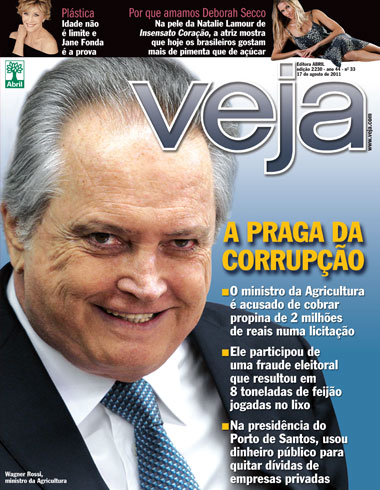
Wagner Rossi, Minister of Agriculture, has just left Dilma's government - he is minister number 4 to go due to corruption charges. Who were the other three?

1. Antonio Palocci, "Home Affairs" whose net wealth miraculously increased twenty-fold from 2006 to 2010. He had already been forced out in a corruption scandal during the Lula government in 2006 - some people never learn.

2. Alfredo Nascimento, "Transportation", accused by Veja Magazine of organizing a true corruption structure in all public transport biddings. Nascimento had been minsiter for two terms under Lula too.

3. Nelson Jobim, "Defense", after calling fellow government colleagues "idiots" and after stating that he had voted in José Serra in the 2010 presidential bid. Jobim had been in the Lula government since 2007.

And why did Rossi leave? He was accused of receiving and distributing huge sums of money in public auctions, embezzlement and of flying around in the private jet of a company that won one of the biddings. He was also accused of electoral fraud, which resulted in, among other things, of throwing away several tons of food staples. He was NOT a minister under Lula, but did command the powerful Companhia Nacional de Abastecimento, charged with stabilizing seed, fertilizer and food demand for the poorer parts of the society.

This does not throw a lot of good light on Lula.

Wednesday, August 17, 2011

Linklist of the week

For lack of time to actually write something, at least my latest reading list:

Wednesday, August 3, 2011

Difficult to Digest Big Mac

Source: The Economist

The Economist released its latest Big Mac Index Study last weekend and, at least for those in Brazil or with very intensive contact to Brazil, the result is not a surprise. The Big Mac Index, according to the newspaper can be described as follows:
Burgernomics is based on the theory of purchasing-power parity (PPP), the notion that in the long run exchange rates should move towards the rate that would equalise the prices of an identical basket of goods and services (in this case, a burger) in any two countries.
If we apply this to Brazil and look at the chart above, we will see that according to this index, the BRL is overvalued against the USD by ca. 50%. Now this is fairly imprecise, as the Index does not show the relationship to GDP per person. The Economist recognized this and adjusted for GDP per person... and now the BRL seems even more overvalued...

Now I did study economics and although I have been outside of my field for quite a while, I believe that such a strong disconnect (BTW, also for Argentina) implies four things:
  1. The Big Mac Index is flawed (not likely),
  2. the Brazilian average GDP is set to rise to the level of the USA in a short timeframe (desireable but not likely), or
  3. that the BRL is in for a huge devaluation...
  4. or inflation within the next few months.
There is of course a further possibility: That the current scenario simply shows a temporary disconnect of several economic factors caused by fear of a destabilization of US and European economies, that several countries are threatened by defaults or at least rating downgrades and a flight to "safe harbors", such as Brazil is occuring.

I find it hard to believe that any of the four... five factors can explain the current scenario - but given the size of the gap I believe we are in for one severe indigestion.

Thursday, July 28, 2011

The R-Word?

The last few months have been very strange. As mentioned in the "about me" section, I work for a chemicals company and while we are in specialty chemicals, many of our suppliers and market partners also are in a broad range of chemical commodities.

What is strange is that while everybody keeps talking about Brazil being the country of the future and with growth opportunities everywhere, we, our market partners and suppliers have started to feel something weakening. While raw materials have spiralled out of control around the world, the favorable exchange rate has kept imports somewhat in check - so raw material costs are not on the levels of the rest of the world. Thus, the lack of demand cannot really be based on cost, or at least not fully. So consumer demand is still also up and capital inflows have remained strong?

To check if it really is just my neck of the woods, I have consulted people in the automotive industry: Demand is down... And I have checked my favorite indicator: Diapers. Diapers is not something that you stop buying just because the economy is down - in fact, it probably would be one of the last things that you would stop buying... yet even here a huge diaper producer in Brazil has told suppliers to slow down on deliveries... Is consumer demand weakening?

As the central bank has hinted that interest rates may start falling soon (after all, the 12.5% already are the maximum level that the bank wanted to reach... in December) and that commodity prices have peaked... and capital inflows have been mainly due to high real interest rates, and not so much to invest in the country.

I would not call it a recession - there is just too much business activity going on, but the economy continues on the brink of overheating, especially in real estate. Infrastructure is not keeping up to the demand, and the creaking is becoming visible on all ends. If consumers start balking too - and consumer indebtness has gone up strongly in 2011 - then the economy may be in trouble.

I would not go long on the BOVESPA if I were you...

Saturday, May 28, 2011

C is for Corruption

Let us hope he showered
Transparency International publishes an annual corruption perceptions index, where "the degree to which corruption is perceived to exist among public officials and politicians" (TI.org) is measured. A non-corrupt country gets a 10, a corrupt country gets 1. In 2010, ranked first in the list is Denmark with a 9.3. Last on the list is Somalia with 1.1. Brazil is 69th, between Romania and Bulgaria, at a 3.7... improved from 4.0 since 2002.

Alot has changed, especially in the private sector, with more multinationals coming into the country, bringing higher compliance standards in and with Brazilian companies also adapting, often because of compliance codes, but also because of better fiscal controls, such as with the electronic centralized invoicing system nfe: nota fiscal eletronica.

In politics, corruption still is a major issue, such in the Escândalo do Mensalão no Distrito Federal, where the then governor of Brasília José Roberto Arruda was accused of (and subsequently arrested for) siphoning off on significant sums of governmental funds to companies and political companions. What made this case spectacular is that Arruda filmed several of these money hand-overs (as depicted above) - but it is not singular.

But also in the private sector, corruption is still a problem. Having been in Brazil for a few years now and never having lost contact between the early 90s and now, when I was out of the country, I have several accounts of corruption cases which have not made it into the media (yet), which I will post in the next few weeks.

But let us start with a juicy one - to protect those involved, I have anonymized each case:

The Paper Company

A major paper company wanted to install a new factory in one of the poorest states in the Northeast of Brazil. Because the company wanted to have the local political buy-in, they decided to meet with the governor to discuss the licensing and subsequent construction - for this, the president of the company flew in. In the first meeting, the governor clearly stated that no license would be emited unless an upfront payment would be made. This upfront payment was to be a deposit into a personal account of the governor and the value was a significant 6-digit value. Infuriated, the paper company president left the governor's palace and instructed to shutdown all non-crucial activity in the state immediately. The new factory will be built a few kilometers down the road... in the state next door.

Thursday, May 26, 2011

Queues in Brazil


The befriended blog Expatbrazil has a nice post on one of the marvels of Brazil: Queues!

Wednesday, May 25, 2011

Brazil, Country of the Present

Copyright Infringement?
It's funny what googling "Brazil, Country of the Present" will show you. Along with this site, a presentation from HSBC for one of their funds. The presentation carries this title and is from January, 2011 - the news is spreading.

The presentation itself is more of a sales pitch than any real information, but feel free to download it here, while it lasts.

Disclaimer: Providing a link to this document is not an offer or invitation to make an application to invest in this fund. All statutory requirements concerning impartiality of financial analysis are unaffected. A prohibition of trading concerning mentioned financial products before publishing this document (“front running”) does not exist. This document replaces neither a professional investment advice nor a relevant public prospectus or any actual semi-annual and annual reports. It is not an offer for subscription.

:-)

Ash and Fog

Made it!
The volcanic ash cloud from unpronouncable Icelandic volcanoes appears to have become a regular phenomenon in Europe. Well, welcome to the club. In São Paulo the winter is approaching and with it the regular phenomenon of fog. Fog is so intense in the Guarulhos Airport area (THE major airport) that the airport regularly closes during fall and winter mornings. This morning was another case - I have two colleagues flying in and both were diverted to Campinas airport, where they are hanging around now before they get sent back to São Paulo - immigration in Campinas is, for some odd reason I do not understand, not possible.

I wonder what the considerations were, when the military junta decided to build the major airgateway into São Paulo in the foggy hole of Guarulhos in the 80s...

But there is really interesting news too: Emirates has asked the governmental airport administrator INFRAERO permission to start using the A380 on their Dubai-São Paulo flights starting December. Their 777-300ER are at 90+% capacity (just like most other airlines heading down here) and they would like to cram in more people. Apparently this could work, if one of the taxi runways were closed during landing and take-off (the A380 seems to have a veeeery large wingspan) and if some adjustments for parking positions were made (for example by scrapping old VASP 727 rotting away on the airport). Infraero has not given a final position yet. Apparently Lufthansa, Air France and Singapore Airlines (which just recently took up Singapore-Barcelona-São Paulo) have also inquired about A380 capacity in GRU. Immigration, which is hell on earth already today, is likely to get worse.

P.S. Emirates will also be flying Dubai-Rio starting in 2012, so the selection of routes into Brazil is expanding.

Sunday, May 22, 2011

The World Cup and a Lack of Sense of Urgency

Yes, pretty it is, but will it be ready by 2014?
Source: Copa2014.org.br

The never-ending story: The World Cup. There is a current blog entry on veja.com.br, coinciding with this weeks cover story. Veja did a fairly simple, if simplistic calculation: How much has been spent so far, how much time until the World Cup, so when will the stadiums get done?

The answer: All but one will be finished AFTER the World Cup.

Stadium Budget Spent to date Conclusion Run-Rate
Corinthians (SP) R$ 1bn Zero Never
A. das Dunas (RN) R$ 400mZero Never
A. da Baixada (PR) R$ 220m Zero Never
Maracanã (RJ) R$ 957m R$ 26m 2038
Arena Pernambuco R$ 532m R$ 60m 2025
Arena Amazônia R$ 499,5m R$ 30m 2024
Mineirão (MG) R$ 666m R$ 86,6m 2020
Nacional (DF) R$ 670m R$ 45m 2021
Arena (MT) R$ 355m R$ 48m 2017
Beira Rio (RS) R$ 290m R$ 30m 2017
Fonte Nova (GO) R$ 591m R$ 99,9m 2015
Castelão (CE) R$ 519 milhões R$ 80m 2013 (October)
Source: Veja Magazine

Is this likely? Probably not. Is this possible? At least for a few of the stadiums, it is starting to seem that way. Why so? Well, apart from a Brazilian lack of sense of urgency (which can drive the German author of this blog mad at times), aparently, there have been some problems with planning. The Brasilia stadium, for example, was planned without grass, seats and illumination (so it will cost more). In the Maracana stadium, the construction company found that the concrete structure was rotten only after tearing out the seats (what a surprise, considering the stadium was completed for the 1950 World Cup on the run and probably not much has been invested since - also here, more will be spent... and it will take a wee longer).

The blog is worth a read, and the issue is worth buying, as it also contains a bunch or pretty pictures of what stadiums should not look like three years before the cup... The first part of the solution will probably be to throw so much money at the construction, to get them finished on time. This has worked in the past: The 2007 Pan American Games were suffering from the same problem, until the government decided to "invest" a bit more in the last six months prior to the games. The result: An overspend of R$3.6bn - instead of R$400m, the cost went up to R$4bn. The second part of the solution will be to reduce the amount of venues from twelve to... 8 or less. Bookmark this page. I am betting on the exit of Manaus, Natal and Curitiba - and Sampa will not host the opening game.

Now, the only question (apart from the many above) is: Where will the 2013 Confederations Cup be held? Oh, and let us not talk about airports this time...

P.S. There even is an official (?) site or the Itaquerão (São Paulo Stadium depicted above): http://www.itaquerao.com/  - But the bandwidth has been exceeded... so Error 509 for you...

Friday, May 20, 2011

Trade War Between Brazil and Argentina?

Rivalry... not only on the pitch
The current situation is not what the former presidents Raúl Alfonsín (Argentina) and José Sarney (Brazil) had in mind, when they signed the PICE (Programa de Integração e Cooperação Econômica Argentina-Brasil), commonly heralded as the precursor of the South American free-trade market Mercosur. At the time, the program even proposed a common currency, the Gaucho...

The situation has become rough. Argentina is not known for freedom of trade - it frequently figures in the list of countries with the most trade barriers and of the least free capital flows. However, this has usually been limited to evil empires such as the USA and China. But things have become more serious with Argentinas most important trade partner, Brazil.

Argentina exports 2bn USD of foodstuffs to Brazil, but Brazil also exports 500m of foodstuffs the other way around. So when Argentina started raising barriers in foodstuffs, Brazil retaliated. Things then escalated to the point when, last week, Brazil stopped emiting automatic licenses for automobiles from "neighboring countries", affecting Argentina strongly. Since then, each import process requires a separate license. Hundreds of cars are stuck at the border, awaiting licenses to be emitted.

The trade barriers today between both countries already affect, food, shoes and clothing, some machinery, some chemicals and more to come.

Alessandro Teixeira, Development Minister in Brazil and the Industry Secretary in Argentina, Eduardo Bianchi, have scheduled a meeting to discuss on how to proceed... and possibly try to figure out how all of this really started - the situation is pretty botched up and is affecting a high demand of imported goods in Brazil (due to a cheap USD and strong Real) adversely. If the situation escalates, which it surely may, large industry sections may continue to be affected.

Monday, April 25, 2011

1000km of traffic jam... every day

Lies, nothing but lies...


I just read that in 2010, Germany had a total of 400.000km of registered traffic jams. I am not really sure how those were computed, but I assume they took the maximum length per occurence. This would then amount to a total of 1095km per day. The automobile club ADAC, the voice of all German drivers, advocates building more and better streets, claiming the situation to be unbearable.

Clearly, nobody from the ADAC has ever been to São Paulo. On any single day at any single time, please feel free to visit the website of Apontador/Maplink, which, in a partnership with the Radio Station Sulamerica (specialized in traffic reports and affiliated to the insurance broker ING), will show you a picture that would make the Germans gasp.

On a normal day, before and after rush hours the website will register between 150 and 200km of traffic jams. In the mornings and evenings, the length can easily double. So, if we take morning, noon and evening as separate incidents, we also get 1000km of traffic jams a day... just in the metro area of São Paulo.


Personally, although I don't feel that way, I can be considered lucky: I have a 33km commute and it takes me 45-60min in the morning and 60-70min in the evening, putting my average speed at about 35-40km/h. The average in São Paulo is below 20km/h. The reason for my "luck" is that of my 33km, I have 29km on 2-4 lane expressways and drive against the flow (I live in town and work outside). Nevertheless, awful situations occur: A few weeks ago, like every morning, I left home at 6:25 - and I arrived at work at 10:40...

Time Magazine ran this nice article a few years ago, and every single word is true. Recently, I had a meeting scheduled for 9:00 on Avendida Paulista (downtown) and I live in the southern zone, ca. 18km away from there. I decided to play it safe and left home at 7:30. At 9:00 I was sitting inside a McDonald's, reading a newspaper and sipping a cappuccino after calling to the meeting and telling them I could not make it (nobody was upset, everybody understood the reason). I had simply given up

Why all of this? Road infrastructure is a mess, public transportation is not even close to adequate (I have seen small towns in Germany with a subway network of similar extension to the one in Sampa) and the amount of cars is amazing. The city of 11m people of has a total of 7m registered vehicles, of which 5.1m are passenger cars... and 1000 additional ones are added every day...